Morebusters
An application work sample: a fact-checking app and an ebook.
- ROLE
- Solo · agent-built
- STACK
- Convex · TanStack · Expo
- VOICE CORPUS
- 115 videos
- SHIPPED
- Inbox · ebook · iOS app
Morebusters began as a work sample for an application with Christian Wolf, founder of MORE Nutrition. The brief asked for an ebook based on two of his videos, in his tone, and a web app that finds popular videos with false nutrition claims and helps him prepare a correction. The brief was clear about what they were looking for, so I started right away. I built a design system from MORE and its universe in Claude Design, found the name quickly, worked out what I wanted to build, planned it and built it fast. It was great to work at that speed. The required part took about two and a half days. The extras came in the week after.

Where the videos come from
I did not want a spray-and-pray approach of scraping the web for relevant videos. MORE has a huge online community, and it already does something useful: when people see a video spreading false claims, they tag Christian Wolf under it. So the app starts from that signal. It takes videos from Instagram mentions and DMs, plus pasted links, and that already filters for what his audience cares about. It builds on how the community behaves anyway, which makes it the most advanced approach that is still acceptable.
"Die Community ist der Filter. Die KI ist der Analyst. Chris ist der Richter."From the concept
The inbox
The app uses Convex behind a TanStack Start front end. It transcribes each video and extracts the claims. A research agent checks them against an index of known myths, PubMed and Europe PMC; everything around it runs as a fixed pipeline. The model has to write a counter-argument before it gives a verdict. Testing it by hand in the first night, I found it had flagged a podcast with Christian himself as misinformation. After that it first works out what a video actually argues, then judges it. The reviewer sees the sources and accepts or rejects the result.
The reply scripts are written in his voice, which the brief did not ask for. For that I built a voice profile from 104 Instagram clips, plus a separate long-form profile from 11 YouTube talks. A checker for the EU rules on health claims counts possible issues in a script and shows them as hints; it never blocks the writing.
The ebook
The ebook, "Heißhunger", has 41 pages in eight chapters. It is based on the two source videos and the wider corpus, labels scientific claims by strength of evidence and includes PubMed references. The layout is HTML with a pagination script and the app's design tokens. The chapter images were generated from Christian's photos, as the brief asked.
The iOS app
The Expo app is for reviewing videos on a phone. Each card shows a video, its claims and a priority score. Swipes accept, reject or set it aside; a separate action assigns it to a teammate. Accepted videos move onto a production board. The app is on TestFlight with a demo login and runs on its own demo data.
Zerup Remix
Christian had announced an Instagram contest for people to share their syrup combinations. I built a working version with a public feed, a combination builder, voting and share cards, as an extra proposal next to the brief.
More Arcade
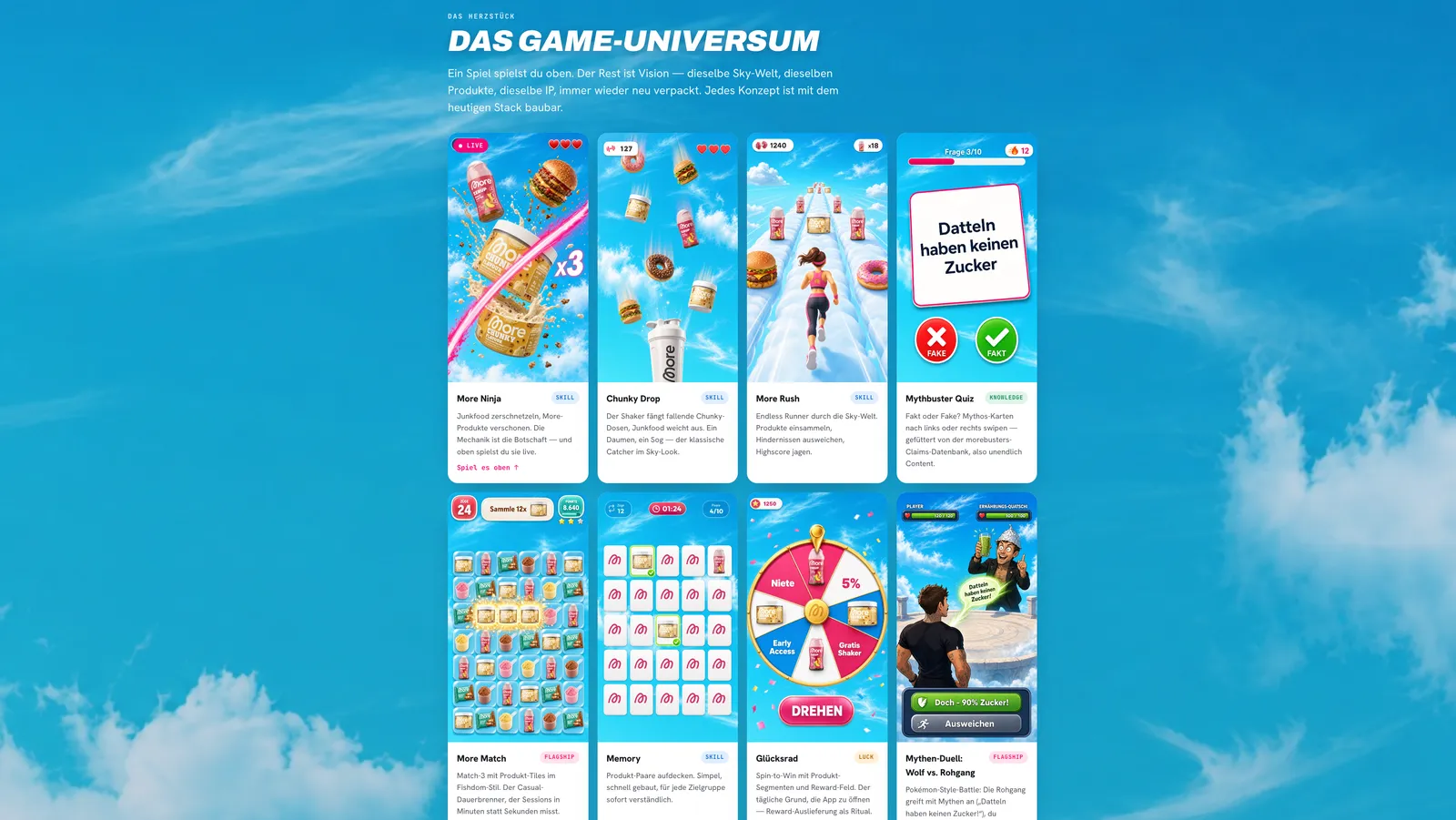
I also built More Ninja, a Fruit Ninja-style browser game with MORE products. It runs as a single canvas app without a backend or build step. The other games on the page are visual concepts, a proposal for a mobile channel where the brand could reach customers directly.
Follow the money
This part I did because the topic interested me. Many of the accounts that attack MORE or Christian sell products of their own, and early on that told me that criticism and economic motives often go together here. Christian is certainly a controversial character. But I have always been interested in following the money: who profits from what, when and how. Looking behind the scenes, opening the commercial register and reading where interests overlap and conflict.
Starting from twelve accounts, the analysis grew to 127 accounts, their shops and 539 transcribed videos. It showed that there are structures, and the results are relevant. In this sample, 71 percent of accounts with a personal affiliate ID spread documented falsehoods, compared with 24 percent of accounts where no money flow turned up.